Three UNESCO World Heritage Sites, two thousand years of civilisation and one of the most extraordinary archaeological landscapes in Asia.
The Cultural Triangle of Sri Lanka is one of those rare travel experiences that exceeds expectations regardless of how high you have set them. A roughly triangular region in the north-central province, it is defined by three UNESCO World Heritage Sites – Anuradhapura, Polonnaruwa and Sigiriya – within easy driving distance of each other, along with Dambulla Cave Temple and the medieval hill city of Kandy at its southern apex. Taken together, they present the full arc of Sri Lankan civilisation from its earliest recorded centuries through to its extraordinary artistic and engineering achievements in the medieval period.
Anuradhapura: The Beginning of Everything
Founded in the 4th century BC and continuously occupied for over a thousand years, Anuradhapura was the seat of Sri Lankan royal and religious power for longer than most countries have existed. Its Sacred City holds the Sri Maha Bodhi Tree – the oldest documented living organism on earth, planted in 288 BC and tended without interruption by an unbroken line of custodians ever since. Alongside it, a series of colossal white dagobas rise above the forest at a scale comparable to the Egyptian pyramids. The ruins of the vast Abhayagiri Monastery, which once housed over 5,000 monks and was one of the most significant Buddhist scholarly centres in the ancient world, spread across the surrounding parkland in a state of photogenic, tree-shaded decrepitude that rewards hours of unhurried exploration. Anuradhapura is best visited by bicycle, available at the entrance.
Polonnaruwa: The Medieval High-Water Mark
When Anuradhapura fell in the 10th century, the royal capital shifted east to Polonnaruwa – a more compact and better-preserved city that enjoyed two centuries of extraordinary achievement under kings who combined military ambition with genuine artistic vision. The Vatadage circular relic shrine, the towering Lankatilaka image house and above all the Gal Vihara stand out: four colossal Buddha figures carved directly from a single granite face with a precision that stopped visitors in their tracks in the 12th century and continues to do so today. The 15-metre reclining figure is carved with such nuanced detail – the slight depression at the pillow, the expression of perfect stillness – that it is almost impossible to look at it for long without feeling the quality of silence the sculptor was trying to render in stone. Polonnaruwa is also best explored by bicycle.
Sigiriya: The Most Dramatic Site in the Triangle
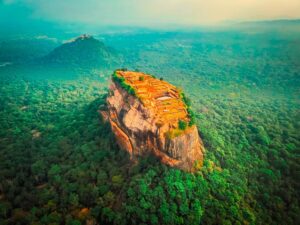
Sigiriya is, by any measure, the most visually dramatic ancient site not just in Sri Lanka but in South Asia as a whole. A volcanic rock plug rising 200 metres from flat forest plains, it was chosen in the 5th century by King Kashyapa as the foundation for a royal palace complex of extraordinary ambition. The approach passes through sophisticated ancient water gardens still partially functional today, then climbs past a gallery of frescoes depicting celestial maidens painted on a sheer rock face. A polished plaster mirror wall alongside the climb bears inscriptions left by visitors spanning a thousand years – among the earliest Sinhala literary writing in existence. The summit, with its 360-degree view across the Cultural Triangle, rewards every step of the climb with a sense of arrival genuinely difficult to prepare for.
Practical Advice for Visiting the Cultural Triangle
Allow a minimum of three days for a serious visit, with four or five being more comfortable if you want to avoid rushing. Sigiriya is best climbed early in the morning before the heat builds and the tour groups arrive – a 6am start will have you at the summit in relative solitude. Anuradhapura requires a full day and benefits enormously from a specialist guide who can contextualise what you are looking at. Polonnaruwa can be covered in a half to a full day depending on your pace. A Cultural Triangle Permit covering multiple sites is available from the Cultural Triangle Authority and represents good value for visitors planning to see all the major sites.